Wednesday, 25 December 2013

Christmas in China

Technically, I've spent the day before Christmas Eve onwards in the UK, but the whole of the run up towards Christmas was in Shanghai, and my department also held Christmas party before I left, so I thought it would be interesting to report on how Christmas is celebrated in a country to which it is so new. 
Of course, Christmas is not a traditional Chinese festival, and they don't get any holiday for it, but as with everything, there is a keen interest in anything Western at the moment, and nowhere more so than in the expat haven that is Shanghai. As with Halloween, Chinese people were aware of these Western traditions, and many people erroneously wished me Happy Thanksgiving when it was on (not realising that it is only a celebration for Americans), and the shops had sales for Black Friday. They also started to have Christmas decorations up when December started and were playing western Christmas songs by the time I left, but most people don't really know what any of these celebrations are about, and the shops just seem to be using it as an excuse to drum up more sales. Definitely, I was very pleased that interest in Christmas only seemed apparent after Thanksgiving had passed, unlike in the UK, where supermarkets encourage us to start stocking up from October onwards! The Chinese love of lights also meant that there were some really beautifully lit up shopping centres and streets.
Christmas lights on a street near Lujiazui
Christmas lights on a shopping mall at Lujiazui roundabout
Lights at a shopping centre on Nanjing Road West. A little bit premature during November, but pretty nonetheless! This photo was featured on the Zai_shanghai Instagram page
On the first weekend of December, there was also a really lovely Christmas market in the French Concession part of Shanghai, that was so close to an authentic one that it suddenly made me homesick. Until that time, I didn't really think about Europe, because I was so busy exploring and learning about Chinese culture.
Christkindlmarkt at Paulaner Brauhaus on Fenyang Lu
It was fairly busy and packed with people, not just because it was squeezed into a fairly small space. When I went, I saw several of my dorm mates there and on top of that there were plenty of curious Chinese people there too, eager to learn about these Western traditions (I guess this is just like how I like to turn up at the Chinese New Year celebrations in Nottingham each year!).
Apparently this place has a Christmas market on every year, and this year was better than ever. They had the most amazing tasting Gluhwein (German mulled wine) I've had in a very long time, and it was worth every penny. The 25 RMB entrance fee we thought was a bit unnecessary, but it turned out we could use the cost of the ticket on something from one of the stalls inside, so essentially, entrance was free, as long as you bought something. 
We didn't buy too much else, but it was a great experience, really pretty, and the quality I'd say was on almost on a par with any of the Christmas markets at home from Prague or Vorosmarty, and better than some of the ones we get even in England. The only thing that was missing was some kurtos kalács! Oh well, we can only dream!

Generally, the Chinese don't really give presents for special occasions like we do (which I discovered almost as soon as I got there, when certain lab people had a complete inability to wrap anything prior to autoclaving!) When it's someone's birthday, friends don't buy them drinks, but they buy their friends drinks! There were two birthdays in the lab while I was there, and on the first occasion, the birthday girl bought everyone milk tea, and on the second one, the birthday girl bought a big cake to share with everyone. On another occasion, a professor in the department had just had a new baby, and to celebrate, he bought everybody in the whole department a little box of some sweets, a bit like a favour box at a wedding. I didn't really understand how this could be a sustainable social rule, and I tried to explain that having babies was very expensive and that when someone has a baby in the UK, we get them presents or vouchers, to help towards the cost of looking after the baby. They just laughed and said, "yes, but in China it's the other way round". Nevertheless, some of my Chinese friends tried to be part of the Christmas tradition and got me some small gifts, a fan and chopsticks to remind me of my stay there.


Early December, it was also decided by the lab management team that this year we would have a departmental Christmas party. I suspect this was in no small way due to my presence, seeing as the last time the department had a Christmas party was three years ago (which coincided with the last time a western person visited the lab at Christmas time) and also because the party was conveniently scheduled just in time before I left. Nevertheless, I was very touched and happy that the lab were marking my presence and/or departure in some way, and although I didn't know everybody in the department, I thought it would be a great way for everyone to have a little fun and time off from the lab.
And boy, did the department put on a spread!  

Christmas party spread in our meeting room, with Prof Ou on the right hand side in a Santa hat 
They spent hundreds of pounds on food, drinks, microphones and decorations, including Santa hats, reindeer headbands and light up Minnie Mouse headbands too. There was also a tombola with prizes like phone chargers, memory sticks and the first prize was top of the range speakers! Clearly there was no expense spared, and I know that they spent the equivalent of about six hundreds of pounds, which is a huge amount in Chinese prices. It was quite clearly going to blow out of the water anything that my department at home has ever put on, simply because this department allowed a bigger budget for the party.
But the best part was that this party was going to be done in the Chinese way, which meant that everyone was going to do some kind of performance, kind of like a cabaret or variety show. Apparently, this is a very traditional way of parties in China, and my Chinese friend who's lived in the UK for nearly ten years was surprised that this way of celebrating had survived this long. I was happy to give it a try and excited to see what it would be like. And as the guest of honour, I was asked to perform first!
This came about because since it was discovered that I could play guitar (I mentioned that I used to play one time, so this automatically made me an expert apparently), so I was asked to perform some Western Christmas songs. But I'm really not that good, and I'm terribly out of practice. Last time I played seriously was when I had lessons with a self-taught, ageing rocker ten years ago, above a second-hand record store in Hull. I could remember most of the chords, but I'd never performed a song whilst playing guitar at the same time! The prospect slightly terrified me, but I didn't want to back out of a Chinese tradition and let the team down. So after some surreptitious practice sessions in my dorm room which I attempted to do as quiet as possible, followed by some louder sessions in the park (during which I was approached by some Chinese guys who were very interested in taking pictures, including borrowing the guitar to pose with it, while I tried to protest in my best Chinese: 这不是我的吉他!这是我朋友的).

Performing "Last Christmas" and "All I Want is You" as the opening act at our departmental Christmas party
The performance went relatively well, although I forgot to take a microphone, so the end result is available to watch, but very quiet and a poor quality recording. If you're still interested, it's here on YouTube and YouKu, depending on what country you're in and how good your VPN access is! The two songs I chose to do were "Last Christmas" (a massive hit in China apparently, so I was compelled to do it even though it's so simple and boring, just same four chords over and over again) and "All I Want for Christmas" (a much more challenging song, which I actually like, although I can't possibly live up to the Mariah standards, and her trained whistle register).
This was followed by some hilarious Bollywood dancing from a group upstairs:
Hilarious Bollywood dance performed by another lab. Had everyone shouting for an en core
My lab also performed a song together, although it was all in Chinese, so they didn't ask me to join in, but it was really cute, and there is also a video here:
My lab singing a cute Chinese song. Even Prof Ou joined in on the extreme right!
The rest of the evening had several more performances, including a duet by two of the married supervisors in the department, and also a song by the head of department, Professor Deng! After all the official, scheduled performances were over, the evening descended into a home KTV, where the guys accessed what seemed to be a karaoke version of Spotify, where you could stream any song that was converted to a backing track and had the lyrics appear on the screen, so it was a free-for-all to ask for any song they wanted. I was asked to sing the Dido part for Eminem's Stan in a duet with DB's room mate, which was great fun. 
Duet with Xu Min, doing Eminem's "Stan"
I really enjoyed my evening, and I much preferred it to English parties, where people just turn up and get drunk! Even though I strongly suspect that this was a show with the main intention that I go home and tell everybody how awesome China was, I think everyone had fun, so it was worth it. I think it's safe to say that their plan worked!

The only downside of Christmas in China was that the cleaning lady and one of the security guards were a little bit surly, and when we got the Christmas tree we had in our dorm out from underneath a staircase, they proceeded to break it and throw it away, followed by replacing it with a very ugly plant. I can only assume that these Shanghainese workers objected to us having any fun because they had grown tired of looking and cleaning up after us, and so they wanted to give us some kind of personal insult. But other than that, everyone else seemed very friendly and inquisitive towards Christmas, and I know that my dorm mates who are studying Chinese also had a party organised for them. The other downside, of course, was that the imported Christmas foods at the Western supermarket cost double the price than at home! It was £5 for one imported chocolate Santa! So I gave that a miss. 
But overall, just because it's the other side of the world and not a traditional festival in their country, I think there is a great Christmas to be had in Shanghai :)

Saturday, 21 December 2013

On leaving China

So, in less than 24 hours, I'll be boarding a plane to go back to the UK. After three months, I've had such a great time here, it will be an emotional goodbye, but I am looking forward to certain things:

1) Christmas dinner with all the trimmings! I'll be home in time for Christmas, but due to complications with my family and my husbands working hours, I'll be staying in Leicester for Christmas. This means I will be making Christmas dinner all by myself, but at least I can do it just the way I like it :) So this means roast potatoes! Stuffing! No sprouts! Brandy butter! Cointreau cream! Snowballs! (although I did have a very tasty snowball this week at a western bar).
2) Radiators! Or not having to sleep with all my clothes on and coat and gloves and socks just to keep warm during the night. My air con has a warm setting, but the timer is limited to one hour, so I always wake up at some point during the night when it has been off for a while, and due to the poor insulation and lack of double glazing in my huge window, the temperature of the room pretty much goes down to a similar level as what it is outside. I'm so looking forward to going to home to my 13.5 tog down duvet and central heating!
3) Washing my clothes! This is one of the first things I'm doing when I get home. The laundry in the campus is really so terrible, and my clothes frequently come back with the same stains on that I'm not sure if they ever really washed my clothes or just made them wet so it looked like they did something. I know a lot of people suspect that they just use cold water in the machines which makes their washing power much lower. But I have also tried to hand wash things myself with hot water, and the "detergent" (if it can be called that) is pretty much useless with any grease stains. Sure, it lathers up nicely to look like it's doing something, but if you ever have a mishap with greasy food, that T-shirt will now become your lounging-around-in-your-room T-shirt. Several of the others in my dorm have told me they have the same problem. On top of that, one time they just took my money and didn't wash my clothes at all, so I swore never to use their services again.
4) Being able to read menus and being fairly certain of what's coming! This was more of a problem at the beginning, but now that I've got a fairly good experience of what Chinese dishes are like, I know what kind of food to order and roughly what to expect. Since I've picked up a few words, I am better able to ask for what I want when I'm by myself too. My reading is still very poor, and my speaking needs a lot of improvement, but I do feel a little bit like just as I'm starting to get the hang of some phrases, I'm leaving. Overall though, I made heavy use of translator apps, Google Translate, which I mention a lot, but also another app Pleco which was recommended to me by a Hungarian dorm-mate, and was really, really so helpful with translating text, as it was excellent at recognising characters, even when drawn by someone without any knowledge of how to write Chinese, like me. But in general, I am looking forward to not living my life out of translator apps!
5) Being able to cross the road without fearing for my safety! I guess this is also a little bit redundant now, as I've gotten the hang of knowing when to cross Chinese roads. However, they could still do with realising the benefits of filter lights and lanes, and also roundabouts! (Maybe they just don't get roundabouts yet, like how at first they didn't get the wheel?) Another important thing that all road goers need to discover, whether bus or bike rider, or even metro driver, is to oil their breaks!
Linked to this, I'm happy not to be holding on to a door handle in fear in taxis as the drivers swerve around negotiating the insane traffic that makes you wonder how some people passed their test, whilst not providing functioning seatbelts! I'm also looking forward to journeys not taking three times they should do due to the traffic. It once took an hour and a half to get just to the other side of the river from the campus! Driving really is so terrible in Shanghai.
6) Not having to take toilet paper with me everywhere. Chinese toilets are on a whole other planet. They could have a blog post all of their own. While squatting toilets are not new to me, as they are common in Turkey, Egypt, and we even had them in Crete on our honeymoon, the receptacle isn't really the issue, rather the standards at which they're kept. Also, in 90 % of places, they do also have western style toilets as an option if you're too squeamish about the squatting ones. But, toilet paper is not always guaranteed, and it shouldn't be flushed down the toilet either. On top of that, Chinese people either have a massive aversion to cleaning toilets, or are just not that picky about the cleanliness of them, because so many that I've been to have an intolerable smell, and at one of the more shocking experiences were when Sam and I had the misfortune of using the facilities at Beijing South Railway station, where we both almost fainted from the smell of the ammonia. It was actually hilarious but tragic. 
7) Not having to hear outrageously gratuitious spitting and clearing of phlegm anymore. I can't believe I almost forgot this! Clearly I'm getting used to this sound!
8) Not having to wait ridiculous amounts of time for a table at a restaurant. It's no secret that China has a lot of people, and especially living in a city with the largest population in China, it can get quite busy. When DB arrived in my lab in the UK in May, I did wonder if he was a little bit bored, because I knew Shanghai was a big city, and Leicester is relatively quiet. But he told me he loved the quiet, and that he especially loves not having to queue for restaurants. I didn't really understand that at the time, because I didn't really see how bad it could be. Surely if there were so many customers, they would just build more restaurants? How wrong could I be. Many restaurants provide seating areas outside their establishments for the people queueing and there is usually an electronic system where you get a ticket for your place in line. We once had to wait for one and a half hours! I'm so glad I never have to do that again!
9) Not having to sit through hours of people talking in Chinese while I sit in silence! Obviously, everyone in the lab couldn't speak English all the time, since it would be weird for them to speak English to each other, but there were a few times when they seemed to forget I was there and I didn't understand what was being said all afternoon! The flipside of this, is that I didn't get distracted half as much in the lab, unlike how it sometimes happens in the computer room in Leicester, and we end up in a massive conversation and before you know it, an hour or two has disappeared. So I managed to be more productive in my lab hours as a consequence, but I'm sure I'm not going to miss going to the lab meetings and just reading the English text on the slides whilst wondering what they hell they're talking about for two hours (actually, I pretty much stopped wondering, and just used the lab meeting times to keep up with my e-mails and check the internet on my phone!)
10) Not having to listen to the Xfm's graveyard shift anymore while I'm in the lab. I was happy to find out that the app for my favourite radio station still worked in China, however, the time difference meant that I listened to some really weird music that is normally only enjoyed by shift workers and insomniacs. However, the up side to this was that after lunch, I could catch the whole of the John Holmes breakfast show (which would start at 6 am back in the UK), which I discovered was on the whole, quite funny, and deserving of its awards. 
11) You may be wondering why cheese hasn't appeared so far on this list. Actually, there are a number of things that I'd like to add to both things I'm looking forward to, and things I'll miss. For although I actually really missed cheese at the beginning, I could see that it wasn't necessary in Asian cooking, which tasted great without it, and after a while I just got used to it. That, and the lack of a sweet tooth in the Asian tastebuds meant that I lost a lot of weight, simply by cutting out cheese and sugary things! I'm sure it did me the world of good to lay off these things for the last three months, especially in the run up to Christmas!

But of course, there are so many things to miss about this place.
1) The food. I never thought I would hear myself say this, after coming to the country with such trepidation from hearing horror stories of dubious ingredients and food hygiene standards, not many of which were assuaged by my attempts to familiarise myself with Chinese food before leaving, by watching Ken Hom and Chin-He Huang travelling and eating their way across China in the "Exploring China" series (really Ken, fried rabbit's head on a stick?!). However, as I've discovered the wide variety of Asian cooking with completely different and inventive ways of cooking, there are several meals that I've fallen in love with. My love for máqiú (麻球) I think was adequately expressed in my previous post), and although it seems difficult to make, I am undeterred in trying so, and if I am successful, my lab mates are sure that I stand a good chance in becoming a millionaire, since there is a massive gap in the market in the UK. And despite all of this eating, I've somehow managed to lose about 5 kg without noticing. Who ever said that Chinese food is unhealthy?!
Also, I never really understood what the fuss was about in hot pots (火锅), but honestly I have come to love them so much, that even my last supper that we just came back from was hot pot. It sounds so simple on paper - get a soup and put your vegetables and meat in and wait for it to cook in front of you. I don't know if it's a combination of the spices (I have stolen one of the bags of sauces from the restaurant! Well not really stolen, since they are free) or the freshness of the cooking, but it's really so delicious.
I also love the way that the Chinese have milk tea (奶茶), which is pretty much the way I used to make my tea as a child - 50 % tea, 50 % milk and lots and lots of sugar! The Chinese also add a random selection of things inside, like sweet red beans, cubes of pudding, tapioca, nuts and a whole manner of other things. At least this is something I can more or less recreate at home. There is so much other food to talk about but either I don't know the name, or it's so difficult to describe that I don't have the space here, but these are my top three favourite things!
Before I left for China, I asked DB if he wanted me to bring anything back, or what he missed the most about China. He said that I didn't need to bring anything, but that the thing he missed the most was the food, since you couldn't quite get the same food from the UK. I didn't think this was anything remarkable at the time; of course, anyone away from their home country would miss the tastes of home. But having experienced the breadth of Asian cooking during my stay, I can honestly say I agree with the sentiment!
2) The people, without a doubt, I will miss my lab mates very much, who have been with me every day, answering all my questions, and helping me get by in a new lab as well as a new country in which I don't speak the language. Without them I would not have lasted very long here, and I don't think I would have enjoyed it half as much. 
I will miss all the members of Ou's group who all showed me the meaning of Chinese hospitality
They took special care to make sure that I had a good time, and included me in all their lab activities, which were many. Not just eating together twice a day but also going out together at the weekends or other trips. I think this must be to do with Chinese culture, since I see all the other labs always hanging out together as groups, and they always seem confused when I tell them that it's very hard to get my lab at home together for a meal, when it seems so natural to them. The realisation also dawned on me that Dona won't be in the lab when I get back, so there'll be no one to chat to on those long evenings in the lab, and no one to have musical exploratory journeys with! 
But I loved the guys in the lab here and I really can't thank them enough for their friendliness and hospitality. It's a real testament to their friendly nature that no less than three of them are accompanying myself and my professor to the airport in the early hours of the morning tomorrow.
3) Not having to have any meeting with my supervisor (largely because he is out of practice with his English!). While we're on the subject of lab people, I have to say thanks to my professor, who has been very welcoming and just let me get on with things. He didn't say anything derogatory when the work was going slowly, and I managed to work through the problems to the point where he was very happy with my end results. Granted, I am just a visiting student, so probably I get special treatment. But overall, I think he is a fair supervisor and I think he is doing a good job at leading the group. 
4) The weather. Despite the unusual day of freak weather conditions which meant that the smog in Shanghai hit a new record while Beijing was basking in unusually pleasant air conditions, overall, the weather has been heavenly. When I arrived, it was a balmy 30 degrees during the day, with long, warm evenings that were great for exploring, and the autumn has not been a let down either (apart from it being too cold to sleep, but that's not the weather's fault, it's the inability of the South of China to adopt radiators). The weather has stayed largely dry and sunny, and even today I wore my sunglasses to go out for lunch, which means that there is no danger of vitamin D deficiency or SAD here! Absolutely perfect for me, and reason enough to be tempting me to move here more permanently. 
5) Cheap standard of living. Yes, my scholarship was proportionally lower to fit in line with the Chinese standard of living (only £200 a month), but still, it is perfectly possible here for students to live fairly exciting lives on this little money. The accommodation is extremely cheap (something like £10 a month, or free if you are staff or on scholarship), the meals cost about 70 p each, as I mentioned in one of my first blog posts, and even going out, you can eat a big slap up meal for under £4, if you go to the places aimed at Chinese rather than tourists. Also, the metro takes you from one end of the city to the other in about 2 hours for about 40 p, so it is perfectly possible to explore and visit around different parts of the city on a budget. Even the bullet train is excellent value for money, and I visited Yangzhou and Hangzhou for about £10 - 15 return tickets. Yes, the tickets to Beijing were £50 each, each way, but it was travelling over 800 km!
6) Fantastic ordering and delivery service, right to your door. With personal couriers (or put simply, guys on scooters) going around doing deliveries from 8 am until 9 pm sometimes, delivery can be really fast. In addition, this service goes on throughout the weekend, which is really convenient if you're in the lab and urgently needs some primers or sequencing done. If you order a package, they don't leave if you're not in, they come in to your building and leave your package at reception (yes, this is permitted by the university, although you shouldn't leave your package lying around for very long). This has made buying things so convenient, and living in a big city like Shanghai, it sometimes even means that you get same day delivery for very little charge (Lu once asked me whether it was okay to order something that I asked if it has a 5 RMB delivery charge. I told her that back home, delivery can cost six times as much!). It might be sad to think that this means some people give up their weekends just to deliver our shopping, but at the end of they day, there is a gap in the market for this, and if these people didn't do it, there are plenty of others who would come along who would fill the gap (this is a little like the problem of the builders I described in my skyscraper post). 
7) KTV! Or the plush karaoke bars with their glittering decor and touchscreen selectors harbouring thousands of songs in many languages. I will miss how much the Chinese share my love of singing, and how easy it is to impress them, thanks to my many years of singing in choir!
8) Eating dragonfruit for breakfast every morning! Which I picked up from a local fruit shop run by a cute couple who politely put up with my rudimentary Mandarin. 

Perhaps many of these plus points are due to the fact that I'm living in a big city like Shanghai, and especially one that is particularly friendly to foreigners. Definitely, everything here seems pretty fast paced. In the lab, they always use fast digest enzymes, and run gels at a high speed to get them finished within half an hour and so this generally means that work gets done much faster.Some people may say that Shanghai is not the real China, but I think that is like saying New York is not the real America, or London isn't the real England. Shanghai is every much a product of Chinese culture as the smaller villages and rice fields, and it will definitely always have a place in my heart. Yes, there is the spitting, and as my friend said "people use the street as the dustbin", but right now I want to say "It's okay China, all is forgiven!" I have really loved my time here and I cannot say enough good things about it. But it is a very emotional time now as I write this, as I must go to bed in order to wake up tomorrow for the flight, so this will be my last post from China! 

Merry Christmas, and see you all soon x x x

Chinese wedding photography

Chinese wedding photography - always crazy and over the top?
When I first arrived and my new lab mates found out I was married then inevitably we ended up discussing weddings. They initially told me that weddings in China weren’t really that big of a deal, but somehow I think that was playing things down a bit! My impression of Chinese weddings is that they can be very elaborate, and above all, a lot of effort and money is spent on the photography. All my friends here who are married that I’ve talked about this with had a photography session (usually before the wedding – so none of these superstitions about the groom seeing the bride before the big day and being put off), and the photos tend to focus on these staged shots, with several outfit changes, rather than the ceremony itself. And when it comes to dress changes, I'm talking about five or six dresses. Nowadays most brides will have at least a few white dresses, but there will also be some of coloured evening gowns in addition to one in traditional dress.  My friends told me that most of the dresses are loaned, so they don’t incur that much of an expense, but I know that the photography package can be quite pricey, and many start at around £1000.
When you see the photographers going around with a couple in the city and in the parks, it’s not hard to see why. Normally, wedding photographs will be taken at beautiful or exotic outside locations, and there will usually be at least one photographer, and one assistant carrying around capes to keep the bride warm in between the shots, or extra changes of clothing. Sometimes more people make up the entourage, such as in night shots, when someone is required to hold a spotlight to make sure faces are well-lit. I also saw a few photography groups that included bridesmaids, although traditionally, Asian weddings would only have one bridesmaid, or none at all (so this is probably another aspect of Western influence on the young people of China).
So, after this brief introduction, here is a selection of my favourite wedding photography sessions that I’ve seen on my travels:
Posing at the Bund was massively popular throughout the hot summer nights
A brave bride catches a chance lull in the traffice to pose at the famous and romantic Wai ba du bridge
As one of the oldest universities in China, even my campus attracts some couples hoping to get some romantic shots with the help of their entourage
The recently built Century Park is so huge that you can even hold a wedding there
Western style bridesmaids and groomsmen are becoming increasingly popular, as showcased by this group posing at Fuxing Park

The prize for the most adventurous couple has to go to this pair, who drove out to a relatively remote part of the Great Wall, about 2 or 3 hours away from Beijing in order to get what must have been stunning wedding shots
The competition to have better and more unique wedding photographs has driven a highly lucrative market to become more and more inventive. How about underwater photography? Or dressing up in your policeman work gear for a swat-themed wedding shoot?

What do people get up to in Chinese parks?


This post would be much shorter and simpler if I were to ask the opposite question, what don’t people do in Chinese parks. Because the short answer to the question in the title, is in fact, everything. In Chinese culture, the park seems to be another one of the major hubs of social life, where people treat it as their local community centre. People come to parks whether it’s sunny or cold to do pretty much everything. Need to practice your Èrhú (二胡)? There is space for you here, and no one will mind the noise. Want to have an aerobics class with your friends? Bring your stereo and your friends and do it for free. Want to catch up with the guys over a game of mah-jong (májiàng 麻将) or cards? This is the place to go. Even when it gets dark in the evenings parks can still be quite busy, with ladies doing a dance routine to keep fit or other activities and people doing exercise. So nothing like the deserted, empty and ominous English parks at night, where secret exchanges occur or lovers meet up. So what do people mainly get up to? Well each of the following activities could probably have their own mini blog post, but I’m just intending to give a brief summary of the most common ones here, and most of my blog posts turn into essays anyway. To any Chinese people reading, I hope you are not offended by my comments, they are not meant to be patronising, I just find these kinds of things fascinating because they don't happen in the country where I'm from!

  1) Older ladies getting together with friends for a little exercise - Guangchangwu (广场舞)
Ladies dancing China Guangchangwu 广场舞
Dancing with fans at the campus park early in the morning

Have you ever wondered how Chinese women manage to stay so slim through the years? Well wonder no more, because I'm about to tell you one of their secrets! Ladies dance together at the park or even in the street, all year round (yes, even in winter, when it’s cold) while a mini stereo is playing on the floor. I often wondered how they know the routine to do, but my Chinese friends assure me that one of them is the leader and all the others follow. These women are easily 40 + and more, so it seems cute that they still get together with their friends for some fun times, not to mention getting some good exercise which you so seldom see in the west.
They dance with a range of accessories including fans and scarves. One of my all-time-favourite dancing shots is this one of these ladies dancing on the Bund with fans, but unfortunately the photo quality is rather poor.
They also dance with scarves, which looks really beautiful, and I took many shots of these women dancing at Hangzhou, while my Chinese friend looked on, bored, wondering what the big deal was all about.
Ladies dancing Guangchangwu 广场舞
The range of accessories extends to many more items, some of which I’m not even sure what they are!
Guangchangwu
While we’re on the subject of exercise in parks, Western people are not averse to it either, as I once witnessed a group of white people running an aerobics class in the park, complete with instructor and boombox. The Chinese found this equally fascinating, and crowded round the group, cheering them on, as though it were a dance performance.
Chinese people crowded around some westerners running an aerobics class in Fuxing Park
While we're on the subject of Western hijacking of park space for their own crazy uses, allow me to show you the antics of what seems to be the local tight-rope walking society meeting:
Tight rope walking practice at SJTU campus park
This group seem to be at the university park every Sunday, and more Asian people seem to be joining in too, although the police didn't seem that keen on them attaching their ropes to the trees this week, and soon put a stop to them. 

2) Dancing lessons 
People also do full on dancing lessons in the park, as demonstrated by these couples at Fuxing Park:
Couples dancing lessons in Fuxing Park
Furthermore, they don’t seem to mind anyone stopping to stare at them or taking any photos. They just carry on, completely unfazed. I think it’s cute that older people do proper dancing like this. Who said that romance was dead!


3)  Card or board games
The park is also a place where older Chinese guys get together to play various games, about which they get very enthused. This, I guess is not so specific to China, because it’s common in other countries, as I’ve often seen men out, late, playing chess or some game in some European countries, particularly Greece. But here, the Chinese seem to be so enthusiastic about it, and apparently a little gambling over cards is very popular. It seems like some games get quite exciting, and it is hard to actually get near enough to see what they are playing, because there are so many people crowded round the players! But I know they play mah-jong, Chinese chequers and card games amongst others. Also, this seemed like a definitely men’s only territory, so I didn't want to stray too close for fear of crossing some cultural boundary of which I was unaware.
Card games at Renmin Park
An intense game of something. I'm not sure what, since there were too many people crowded round to see!
4) Water calligraphy on the pavement – Dìshū (地書)
This is very commonly seen in parks and on the street, apparently this art form first became popular in the 1990s in Beijing and then spread to other major cities. Basically, it involves writing on the pavement using only water as the ink with sticks and foam as brushes, allowing an ephemeral artistic expression. It’s a beautiful way of expressing oneself in a transient manner, as artist write poetry, quotes from literature and aphorisms in a cursive style of the traditional Chinese script. With characters requiring up to 20 or so strokes, each character is an art form in itself and people who can write such complex characters are regarded as highly skilled and attract awe and appreciation from passers by, foreign or locals alike. It’s very beautiful to watch the words being painted, then slowly disappear as the water evaporates. 

Dishu 地書
Dìshū at Fuxing Park
Dishu 地書 Hangzhou
Dìshū at West Lake in Hangzhou
There are several really great posts out there on this topic, so I won't repeat them, but my favourite one is this one, because of its beautiful pictures that really give justice to this art form. 

5) Tai chi
You see older people doing tai chi at all hours of the day, and not just in the parks, but also in the street or car parks, and generally random places! They do tai chi, a very slow type of meditative exercise that’s loosely based on martial art moves in order to relax, and keep their muscle tone. It’s a really great way to stretch yourself, a bit like yoga or Pilates, and also to calm the mind. I tried it during my undergrad years, and it was great, so I thought I might be able to take it up here. However, when I mentioned this, my suggestion was met with laughter, and my lab mates just pointed to the people in the park and said that “maybe you can ask some of the old people over there to teach you”. For tai chi is pretty much as uncool as it gets now. (On another note, when I also expressed a love for orchids and boasted that I have three at home, this was also met with more laughter and dismissal, as another “old-fogey” type interest. I guess I am an old lady on the inside!). I think tai chi can be really cool though, and there are many versions, including ones with implements, such as swords!
However, young people prefer more fast paced kind of martial arts, like Wushu, or pretty much they have started adopting western sports. Basketball is by far the most popular sport here, having imported the NBA from America, and you see loads of Chinese guys playing it enthusiastically every day, or watching it on their computers in the lab. I think this might be partly due to some successes of the taller Chinese players who have made it really big in America. For example Shanghai-born Yao Ming, who unwittingly became a big internet meme for his “Bitch, please!” face during an interview.
Yao Ming - internaitonal basketball star, and current SJTU student

After playing for the Houston Rockets for several years, he decided to retire due to recurring foot injuries, and is now currently enrolled at a degree course at SJTU! The others tell me that this is quite common for Chinese sportsmen to focus on becoming a success in their athletic career while they are young, and then starting their undergraduate degree when they retire, in order to have a proper life for themselves afterwards. Unfortunately, he has mainly private tuition on the other campus, to avoid causing a distraction since he is a national hero, particularly here in his home town, both for his successes on the court and his humanitarian work. This means that I don’t really get the chance to see him!

6) Kite flying
This is a big one, since China is the land where kites originated from, as there were readily available materials that were ideal for making kites: silk, a lightweight but strong material to catch the wind; and bamboo for a sturdy, but lightweight framework. Young and old both like to fly kites in the park, and there are plenty of kite sellers hovering around the major touristy kite spots. I too succumbed into buying a kite, reliving my childhood days where I would spend a crazy amount of time flying my huge kite in the fields behind our house, and later sewed my own kite (I know, I was just the coolest kid at school, right?).
Flying my kite at Century Avenue
At only 100 m line, my kite was pretty tame in comparison to the pros who also frequent these kind of places. There are some guys, who can keep a kite going at what seems like above the levels of the tallest skyscrapers. Take for example this guy:
Serious kite flyer at Fuxing Park
You can see from his pretty serious-looking reel that he means business. And even at the highest magnification possible on my little compact, I could only get this image of his kite flying high as a tiny little speck:


There are also a string of mini kites that you can buy, which don’t travel so high, but look really cute:
Chineses Kites Century Avenue
Mini kites at Century Avenue

So, in short, kite flying is a big deal in China (although probably also an old-fogey thing!)


7) Singing
In addition to these other art forms, there is also plenty of singing going on. Sometimes people seem to be holding performances, with an amplifier playing a backing track. I think this is in a similar vein to people practising their instruments in the park, like the èrhús I mentioned at the beginning of this post.
However, this has now included me, since I was asked to perform some Christmas songs at the lab Chritmas party! (eek!) Since I had nowhere private to practise where I didn’t drive people insane, I had to resort to the park option! It was surprisingly good, because on account of the cold weather, there were few people in the park, but those that were there either didn't bat an eyelid, or they just took pictures of me. Some guys also came up to me and took pictures in so many different poses and even asked to pose with my guitar! I couldn't really refuse this, since I have been known to take a fair few photos of èrhú players too. It was actually a fairly liberating experience, and helped me to bring up my confidence prior to the big performance.

8) Marriage markets!
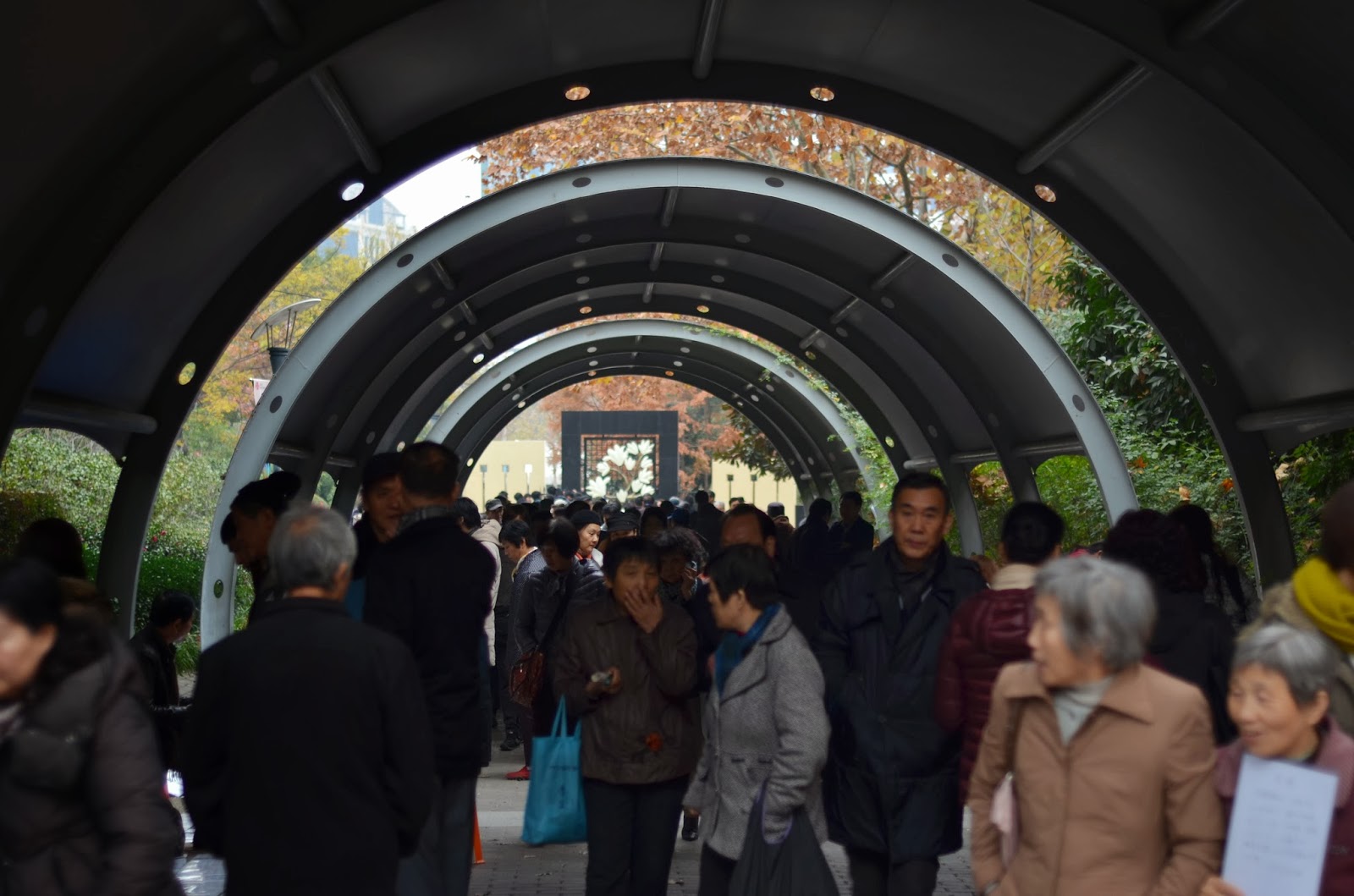
Yes, before match.com, there was the old fashioned paper version! Except this one is run by your parents! The famous Shanghai marriage market at People’s Park (人民公园) in Shanghai happens every weekend from 12 pm, where parents of marriageable aged children who are struggling to find a spouse come to chat with other parents who are in the same position in the hope of finding a good match. I don’t know what is displayed on these ads, but I imagine there’ll be much focus on age and profession and family background, which are very important considerations in Asian culture when choosing a partner with whom to settle down. This kind of system is quite out-dated in most parts, but used to be fairly common. Nowadays, children have much more choice over their partners, although parental approval is still very important for the Chinese, who are very family-orientated and are taught to respect their elders. Before the cultural revolution, it was legal for parents to break up a marriage if they didn't approve of their child's choice of partner!
Shanghai Marriage Market Renmin Park
A marriage arranger displaying his clients at Renmin Park

Shanghai Marriage Market Renmin Park
Looking for Miss Right for my son
Shanghai Marriage Market Renmin Park
People displaying their marriage adverts on umbrellas
Shanghai Marriage Market Renmin Park
Every weekend, people cram two tunnels like this in Renmin Park as part of the marriage market

9) Wedding photography 
Utilising the parks for marriages doesn't stop with planning a wedding! Wedding photography is huge in Asia, and in the warmer months, you’ll very likely see dozens of couples traipsing around through the town and parks with their photography entourage to take photos in a range of outfits and locations. This section already has many photos, so I've decided to dedicate its own post showing my favourite wedding photography moments.

One thing that is clear from all these activities is that just like how there is an absence of “personal space” in China (a concept held so dear to many Brits), there is also an absence of self-consciousness. It’s funny because for a culture that’s so obsessed with saving face and maintaining relationships through guanxi, it’s surprisingly hard to get a Chinese person to feel embarrassed in the way that we know in the UK. Their thresholds are just in completely different places. It’s so lovely that they are unburdened by any such social restrictions and are just free to enjoy themselves without worrying about what others think. If anything people are actively encouraged to express themselves artistically, which is something I love. 

Secondly, apart from the marriage related activities, most of my comments seem to be done by people who are middle aged or older. While my interest in these activities probably shows more about me than anything else, I love that this means that old people don't fade into the background here. In China, elders are not regarded as an inconvenience or a nuisance, but rather are respected and revered. Age equals wisdom in China and this means that as you get older, people listen to you more. I think of the situation in the UK, where old people are shipped off to homes as soon as possible, and the Salvation army runs adverts to ask for volunteers to keep old people company, and I know this kind of situation would be unthinkable in China.


What do you see in your local park? What do you think about the Chinese confidence and sense of freedom in parks?